



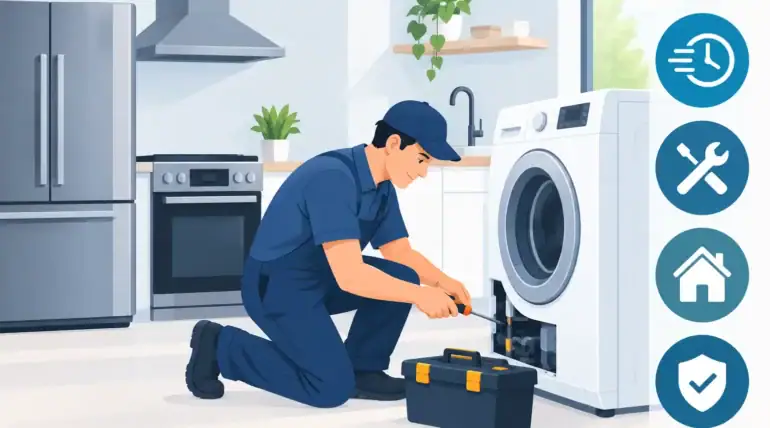
A refrigerator that stops cooling before a busy weekend, a washer that will not drain, or an oven that quits before dinner creates an immediate problem. Understanding how fast appliance repair works helps you know what to expect, what information to have ready, and when a same-day solution is realistic.
At Smart Appliance Repair, fast service means more than arriving quickly. It means clear scheduling, a focused diagnosis, honest pricing before work begins, and a repair that is tested before the technician leaves whenever parts are available.
What Happens After You Schedule Service
Speed starts with the first call or online appointment request. Sharing the appliance type, brand, model number, and symptoms gives the service team a better chance to prepare for the visit. For example, saying that a dryer runs but has no heat is more useful than simply saying it is broken. The same goes for a dishwasher that leaks only during the drain cycle or a refrigerator that is warm while the freezer still feels cold.
Many repair appointments can be scheduled for the same day or next day, depending on demand, location, and the urgency of the issue. Homeowners in the Cincinnati area and other nearby service markets often call when an appliance failure disrupts the household routine. Restaurants and laundromats may need even faster attention because every hour of downtime can affect customers and revenue.
Once your appointment is confirmed, make sure the appliance is accessible. Clearing laundry baskets from around a washer, removing items from under a sink, or making space around a refrigerator can save time when the technician arrives. If the appliance is leaking, sparking, producing a burning smell, or causing a gas odor, turn it off if it is safe to do so and keep people away from the area.
How Fast Appliance Repair Works at Your Appointment
A trained technician begins with diagnosis, not guesswork. The goal is to identify the actual failed component and rule out related problems that could cause the same symptom. A dryer that will not start could have a door switch issue, a failed thermal fuse, a power supply problem, or a control failure. Replacing the wrong part may seem fast at first, but it does not get your appliance back in service.
The diagnostic process usually includes asking what happened before the problem started, checking error codes when the appliance displays them, inspecting visible components, and testing electrical or mechanical functions. For many common issues, this step takes less than an hour. More complex failures, especially those involving sealed refrigerator systems, electronic controls, or intermittent problems, can take longer to diagnose correctly.
After identifying the issue, the technician should explain what failed, what the repair involves, and what it will cost before work begins. Upfront pricing matters because it lets you decide whether repairing the appliance makes sense without pressure or surprise charges.
If the needed part is stocked on the service vehicle, the repair can often be completed during that first visit. The technician installs the part, reassembles the appliance, and runs it through the appropriate test. That final test is essential. A dishwasher repair should include checking for leaks and proper draining. A washer repair should include a cycle test when possible. A refrigerator repair may require verifying that fans, controls, and cooling functions respond as expected.
The Biggest Factors That Affect Repair Time
Some appliance repairs are naturally faster than others. A clogged garbage disposal, a worn dryer belt, a faulty igniter, or a broken dishwasher latch may be resolved in one visit when the correct replacement part is available. These are common repairs with clear symptoms and widely used parts.
Other jobs take more time because the problem is harder to isolate or the part must be ordered. Appliance brands use different configurations, even within similar-looking models. A control board, door seal, pump, sensor, or compressor-related component may need to match a specific model number. Ordering the right part is better than installing a close match that does not solve the problem.
Repair timing usually comes down to four practical factors:
- The appliance type and the severity of the failure
- Whether the technician can confirm the cause during the first visit
- Whether the correct part is available locally or on the service vehicle
- The age, model, and condition of the appliance
Older appliances can sometimes be straightforward because their mechanical parts are easy to access. In other cases, parts are discontinued or difficult to source. Newer appliances may offer useful error codes, but advanced electronics can add diagnostic steps. Neither old nor new automatically means faster or slower repair. The specific failure matters most.
Same-Day Repair Versus Same-Day Diagnosis
These terms are often confused. Same-day service means a technician can inspect your appliance on the day you call or request an appointment. Same-day repair means the problem is diagnosed and fixed during that visit. Many common repairs qualify for both, but no honest company should promise completion before seeing the appliance and confirming part availability.
A fast diagnosis still has real value when a part needs to be ordered. You know what is wrong, receive clear pricing, and avoid losing more time to trial-and-error fixes. The technician can also tell you whether the appliance is safe to use while waiting. In some situations, such as a refrigerator that is not cooling or a washer that is leaking, the answer may be to stop using it until the repair is complete.
For commercial equipment, quick diagnosis can be especially important. A restaurant kitchen may be able to adjust operations around one affected appliance for a short period, while a laundromat may need to prioritize the most heavily used machines. Clear communication gives business owners the information needed to make a practical decision while the repair is underway.
What You Can Do to Help the Repair Move Faster
You do not need to troubleshoot a complicated appliance before scheduling service. In fact, taking apart panels or attempting electrical repairs can make a simple problem harder and less safe. But a few details can help the visit go smoothly.
Have the model and serial number ready if you can find them. They are commonly located inside a refrigerator compartment, around a dishwasher door frame, on a washer or dryer opening, or on the back or side of the unit. Take note of any error code, unusual sound, smell, leaking water, or point in the cycle where the appliance fails.
If possible, leave the appliance in the condition where the problem occurs. Do not reset the breaker repeatedly or run several extra cycles after you notice a burning smell or water leak. For a refrigerator that has stopped cooling, move perishable food to a cooler or another refrigerator as soon as possible. For a gas range with a suspected gas leak, leave the area and contact the appropriate emergency service before arranging a routine repair visit.
Accessibility also makes a difference. A technician may need room to pull out a refrigerator, access a dryer vent connection, or inspect plumbing beneath a dishwasher. Pets should be secured, and an adult who can approve the repair should be available during the appointment. These small steps reduce delays and make it easier to complete approved work on the spot.
When Repair Is the Faster Choice Than Replacement
Replacing an appliance is not always quicker. A new unit still has to be selected, delivered, installed, and sometimes modified to fit existing connections or cabinet openings. If the issue is a common, repairable part and the appliance is otherwise in good condition, professional repair can restore normal use far sooner than shopping for a replacement.
That said, there are times when replacement deserves consideration. An appliance with repeated failures, extensive corrosion, a major sealed-system problem, or a repair cost that approaches the cost of a comparable new unit may not be the best long-term investment. A trusted technician should explain the trade-off plainly rather than pushing a repair that does not make financial sense.
Fast Service Should Still Be Done Right
The fastest repair is not the one with the fewest minutes on the clock. It is the repair that addresses the right problem, uses the proper part, and is tested before the job is finished. That approach prevents repeat visits and gives you confidence that the appliance is ready for daily use again.
If an appliance is disrupting your home or business, schedule service as soon as you notice the issue. The earlier you provide clear symptoms and model information, the sooner a trained technician can help you get back to normal.


