



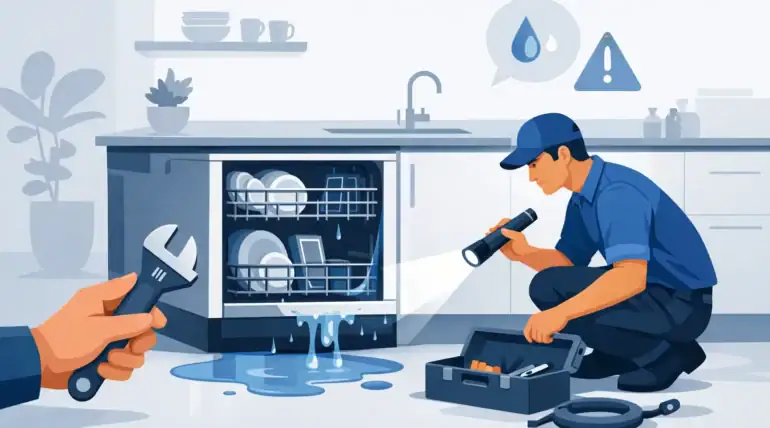
A dishwasher leak usually shows up at the worst possible time – right before work, after dinner, or in the middle of a busy week. If you are searching for how to fix leaking dishwasher issues, the good news is that some causes are simple and safe to check before the problem turns into floor damage, cabinet swelling, or a bigger repair.
The key is not to guess. Dishwasher leaks can come from the door, the drain line, the water supply connection, the pump area, or even from using the wrong detergent. Some fixes are quick. Others need a trained technician, especially if the leak is tied to an internal seal, motor, or cracked component underneath the unit.
How to fix leaking dishwasher without making it worse
Start by turning off the dishwasher and drying the area around it. If there is standing water near the appliance, shut off power to the dishwasher at the breaker before touching anything underneath or around wiring. Safety comes first, especially if the leak has spread across the kitchen floor.
Once the area is safe, try to identify when the leak happens. Does water appear during filling, washing, draining, or only after the cycle ends? That timing matters. A leak during fill often points to an inlet or float issue. A leak during washing may suggest the door gasket, spray arm, or detergent problem. A leak during draining can mean a loose hose or drain connection.
You do not need to take the whole dishwasher apart to narrow it down. A few careful checks can usually tell you whether this is a basic maintenance issue or a repair that needs service.
Check the door gasket first
One of the most common reasons a dishwasher leaks is a worn, dirty, or misshapen door gasket. This rubber seal runs around the edge of the door and helps keep water inside the tub during operation.
Open the door and inspect the gasket closely. If you see food debris, grease, hardened soap, or visible cracks, that may be the problem. Wipe it down with a damp cloth and a mild cleaner, then check for sections that look flattened, brittle, or pulled away from the frame.
If the gasket is damaged, cleaning will not be enough. It will need replacement. That is a fairly common repair, but the fit has to be exact. A poor seal can keep leaking even after a new part is installed if it is not seated properly.
Also check whether the door is closing all the way. If a rack is sticking out, dishes are blocking the spray arm, or the latch is not catching correctly, water may escape from the front even though the gasket itself is fine.
Don’t ignore the bottom corners
If you notice water pooling near the front corners of the dishwasher, the door seal is a strong suspect. In many cases, this kind of leak starts small and gets worse over time as the gasket wears down or the door alignment shifts.
Look at the detergent you are using
Sometimes the answer to how to fix leaking dishwasher problems is not a broken part at all. Using regular dish soap instead of dishwasher detergent can create too many suds, and those suds can force water out through the door.
Even the correct detergent can cause trouble if too much is used or if a rinse aid dispenser is leaking. If you recently switched products and then noticed leaking, that is worth checking. Excess suds can mimic a mechanical problem.
Run a short cycle with the correct detergent and no overloaded dishes. If the leak stops, the issue may have been soap-related rather than a failed component.
Inspect the spray arms and loading pattern
A cracked, clogged, or loose spray arm can send water in the wrong direction. When water is forced directly at the door or gasket area, it may spill out even though the door seal is still in decent shape.
Remove the lower rack and inspect the spray arms for cracks, warping, or blocked holes. Food particles and mineral buildup can affect the spray pattern. If dishes or large pans are preventing the spray arm from turning freely, that can also create uneven water pressure inside the tub.
This is an easy thing to overlook. Many leaks that seem serious are really caused by overloading or poor dish placement. Tall items near the front or lower corners can deflect water toward the door.
Check the float assembly
The float helps regulate water level inside the dishwasher. If it gets stuck, the machine may overfill, and that extra water has to go somewhere.
Most dishwasher floats are located on the bottom of the tub, often near the front corner. It should move up and down freely. If it is stuck by debris or soap buildup, clean around it carefully.
A stuck float is sometimes a simple fix. But if the float switch has failed, the dishwasher may keep taking in water beyond the normal level. That is usually a repair job, since diagnosing the switch involves more than a visual check.
Pull the unit out only if you can do it safely
If the leak is not coming from the front, it may be underneath or behind the dishwasher. That often means a loose drain hose, a damaged inlet hose, a failing pump seal, or a cracked water valve connection.
If your dishwasher is easy to access and you are comfortable doing so, you can remove the lower kick plate and use a flashlight to look for signs of active dripping. In some homes, pulling the dishwasher forward is more involved because of flooring height, tight cabinetry, or hardwired electrical connections. If that is the case, it is better not to force it.
Look for water trails, mineral residue, or damp insulation under the unit. A supply line leak tends to show up during fill. A drain hose leak often appears later in the cycle. A pump or motor seal leak may be less predictable and often gets worse as the machine runs.
What these leaks usually mean
A loose hose clamp may be a straightforward fix. A cracked hose needs replacement. A leaking pump seal or internal housing issue is different – that repair is more technical and usually not worth trial-and-error if you want the machine fixed quickly and correctly.
Don’t overlook the drain and filter area
A partially clogged filter or drain path can cause water to back up inside the dishwasher. That backup may show up as leaking near the door or around the bottom of the unit.
Remove and clean the filter if your model has one. Check for food buildup, broken glass, labels, or grease accumulation. If water is not draining properly at the end of the cycle, the drain hose may also be kinked or blocked.
This is where it depends on the symptoms. Slow draining alone does not always cause an exterior leak, but combined with overfilling, soap residue, or a weak door seal, it can contribute to one.
When to stop troubleshooting and call for service
If you have cleaned the gasket, checked the detergent, inspected the spray arms, and ruled out simple loading issues, but water is still leaking, it is time for a professional diagnosis. The same goes for leaks coming from underneath the dishwasher, recurring leaks after a temporary fix, or any sign of electrical exposure.
A leaking dishwasher can damage subfloors, base cabinets, and nearby walls much faster than many homeowners expect. For busy households and local businesses, waiting too long usually turns a repair into a larger cleanup problem.
At that point, fast service matters. A trained technician can pinpoint whether the issue is the inlet valve, circulation pump, drain pump, door seal, float switch, hose connection, or tub component without unnecessary part swapping. That saves time and helps avoid repeat breakdowns.
If you are in Cincinnati, Columbus, Dayton, Indianapolis, or Louisville and need help with a dishwasher leak, Smart Appliance Repair handles major brands with upfront pricing and trusted local service.
A smart next step if your dishwasher is leaking
If the leak appears once and never returns, it may have been caused by detergent, loading, or a temporary blockage. If it happens again, treat it as a repair issue, not a one-time mess. Water leaks rarely fix themselves, and the longer they continue, the more expensive the damage around the dishwasher can become.
A careful check can tell you a lot, but there is real value in getting a dependable answer fast. When your dishwasher is leaking, the best next step is the one that protects your kitchen and gets your routine back to normal.


