



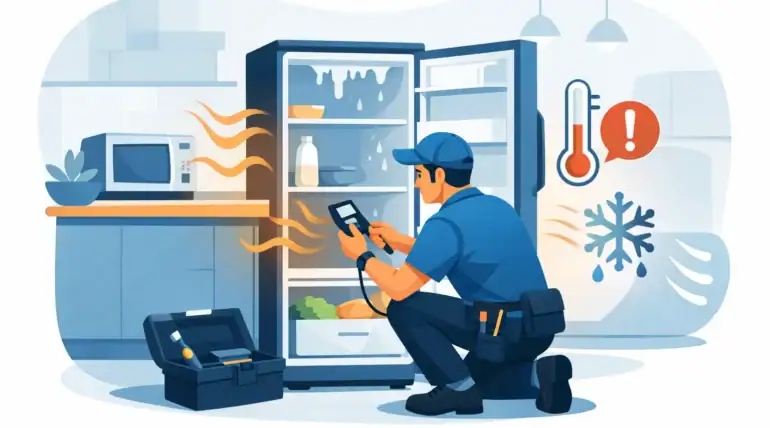
You notice the milk is not as cold as it should be, the freezer still seems okay, and suddenly you are searching for how to troubleshoot warm refrigerator problems before groceries go bad. That is the right move. A refrigerator that is running but not cooling properly can be caused by something simple, like blocked airflow, or something more serious, like a failing fan or compressor.
The key is to check the easy things first. A quick, careful inspection can sometimes save you a service call. Just as important, it can tell you when the problem has moved beyond basic troubleshooting and needs a trained technician.
How to troubleshoot warm refrigerator problems step by step
Start with the temperature settings. It sounds basic, but settings get bumped all the time, especially in busy kitchens, rental properties, and commercial spaces. Your refrigerator section should usually be set around 37 to 40 degrees Fahrenheit, while the freezer should be at 0 degrees. If the control was turned up by mistake, the fix may be immediate, although it can still take several hours for temperatures to stabilize.
Next, check the doors. A refrigerator that does not seal tightly will constantly lose cold air. Look for gaps in the gasket, torn rubber, crumbs stuck along the seal, or doors that are not closing fully because of overloaded shelves. If the door has to be pushed shut every time, that is a problem worth fixing right away.
Then look at how the refrigerator is packed. Overfilling can block vents and keep cold air from circulating where it needs to go. On the other hand, an almost empty refrigerator can sometimes struggle to hold temperature efficiently, especially if the door is being opened often. If food near the back is freezing while items near the front feel warm, airflow is a likely issue.
Check airflow before assuming the worst
A lot of warm refrigerator calls come down to poor airflow. Cold air has to move freely between the freezer and fresh food section on many models. When vents are blocked by containers, pizza boxes, or large platters, one section may stay cold while the other warms up.
Take a minute to locate the interior vents and make sure nothing is pressed directly against them. Rearranging shelves may help more than people expect. This is especially common after grocery runs, holidays, or office fridge cleanouts where things get packed in quickly.
If you hear the unit running but feel very little air moving inside, that points to a different issue. The evaporator fan may not be working properly. That is not usually a DIY repair for most homeowners or business operators, but it is a useful clue when describing the problem during service scheduling.
Dirty condenser coils can make cooling weak
Condenser coils release heat from the refrigerator. When they get coated in dust, pet hair, or grease, the appliance has to work harder and cooling performance drops. In homes with pets or in commercial environments, this can happen faster than expected.
On some refrigerators, the coils are underneath. On others, they are behind the unit. If they are accessible, unplug the refrigerator and gently clean them with a coil brush or vacuum attachment. Do not force anything or bend the coils. Once cleaned, give the unit time to recover. If cooling improves, you may have found the problem.
There is a trade-off here. Coil cleaning is a worthwhile maintenance step, but it will not solve every warm refrigerator issue. If the coils are clean and the temperature still keeps rising, the cause is probably mechanical or electrical.
Listen for fan and compressor behavior
A healthy refrigerator should make some noise. Soft humming, occasional clicking, and fan sounds are normal. Silence when the unit should be cooling is not.
If the interior lights turn on but you do not hear the compressor or fans, the issue could involve the start relay, control board, thermostat, or compressor itself. If you hear repeated clicking every few minutes, that can be a sign the compressor is trying and failing to start. That is a repair situation, not a wait-and-see situation, because cooling can decline fast.
A loud fan noise can also mean trouble. Sometimes ice buildup interferes with the evaporator fan. Other times the fan motor is worn. Either way, unusual sounds paired with weak cooling are a strong sign that professional diagnosis is the next step.
Why a refrigerator is warm but the freezer is cold
This is one of the most common situations people run into. The freezer seems mostly fine, but the refrigerator compartment is too warm. In many models, the refrigerator side depends on cold air being pulled from the freezer. If that airflow is blocked or the defrost system is failing, the fresh food section warms up first.
Ice buildup on the back panel inside the freezer is a major clue. That often points to a defrost problem involving the heater, thermostat, or control board. A manual unplug-and-defrost may temporarily restore airflow, but it usually does not fix the underlying part failure. If the same issue comes back, service is the smarter move.
Damper problems can also cause this split-temperature issue. The damper opens and closes to regulate cold air moving into the refrigerator section. If it sticks shut or barely opens, your freezer may still look normal while the refrigerator struggles.
How to troubleshoot warm refrigerator symptoms safely
Food safety matters here. If the refrigerator has been above 40 degrees for more than two hours, perishable items may no longer be safe to keep. That is frustrating, but it is better than taking chances with spoiled food.
As you check the appliance, keep safety in mind. Unplug the unit before cleaning coils or inspecting accessible components near the back or underneath. Avoid disassembling panels unless you know exactly what you are doing. Modern refrigerators include delicate wiring, sharp metal edges, and parts that can be expensive to damage.
It also helps to avoid one common mistake: turning the temperature setting colder and colder in the hope of forcing a fix. If a part is failing, lower settings will not solve it. They may only make the appliance run harder while the actual problem gets worse.
Signs the problem needs a technician
Some refrigerator issues are easy to spot but not practical to repair without tools and training. If the unit is warm and you notice burning smells, repeated clicking, leaking water with poor cooling, heavy frost buildup, or a compressor that is too hot to touch, it is time to stop troubleshooting and schedule service.
The same goes for businesses. If a reach-in refrigerator in a restaurant or shared kitchen is not holding temperature, the cost of waiting can be much higher than the cost of repair. Lost product and downtime add up quickly. Fast diagnosis matters.
For many homeowners, the decision comes down to age and symptoms. A dirty coil or blocked vent is worth checking on your own. Electrical failures, sealed system issues, and compressor problems are not simple weekend fixes. Trusted local service is usually the faster and more cost-effective path.
What to do while waiting for repair
Keep the refrigerator door closed as much as possible. Every opening lets cold air escape and pushes temperatures higher. If the freezer is still working, move the most perishable items there temporarily if space allows.
You can also place a thermometer inside the refrigerator compartment to track whether temperatures are holding, improving, or continuing to rise. That information is useful when you talk to a technician. It helps narrow down whether the issue is intermittent or constant.
If you are in Cincinnati, Columbus, Dayton, Indianapolis, or Louisville and need quick refrigerator repair, a company like Smart Appliance Repair can help identify the issue fast and explain the next step clearly before any work begins.
A warm refrigerator is never convenient, but it is usually not random. When you check the settings, airflow, door seal, and coils first, you either solve the problem or rule out the basics quickly. And when the signs point to a failing part, getting it handled early gives you the best shot at saving both your food and your appliance.


