



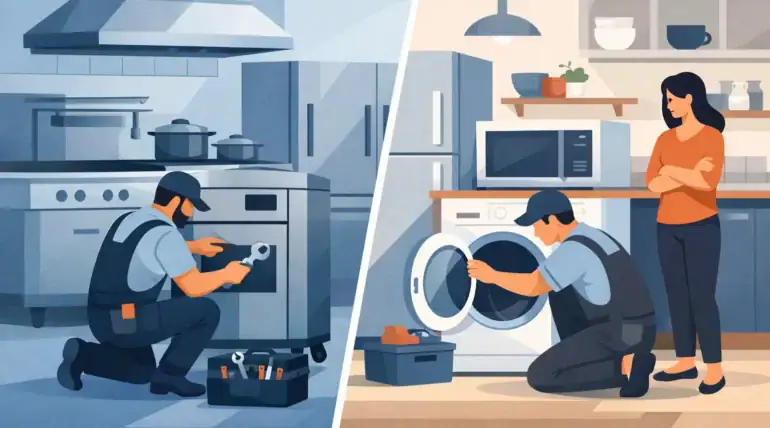
A walk-in cooler that stops holding temperature can derail a full day of service. A home refrigerator that quits is stressful too, but the timeline, equipment demands, and repair process are not the same. That is the real difference in commercial vs residential appliance repair – both require skill, but the stakes, systems, and service approach change quite a bit.
If you are trying to decide what kind of technician you need, or why a commercial repair quote may look different from a residential one, the answer usually comes down to workload, design, and downtime. Appliances built for a family kitchen and appliances built for a restaurant, laundromat, or other busy operation may look similar at first glance. Under the surface, they are not.
Commercial vs residential appliance repair: what changes?
The biggest difference is how the equipment is used. Residential appliances are designed for daily household routines. Commercial appliances are built for heavier demand, longer run times, and more repetitive cycles. That affects how they fail, how they are diagnosed, and how quickly they need to be back in service.
A residential dishwasher might run once or twice a day. A commercial unit may run continuously through meal service. A home dryer works around a family’s schedule. A laundromat dryer may be in use for hours with very little break. Even when the basic function is the same, the wear pattern is completely different.
That is why commercial repair often requires a faster response, more specialized parts knowledge, and a technician who understands higher-capacity systems. Residential repair, on the other hand, often focuses on restoring convenience, protecting food, and helping a household avoid the cost of replacement.
Why commercial equipment needs a different repair approach
Commercial appliances are tied directly to revenue, staffing, and customer experience. When a restaurant oven will not heat evenly or a commercial washer is down, the problem spreads fast. Orders back up, employees work around the issue, and the business starts losing money.
That urgency changes the service call. Commercial repair is often less about “Can this wait a few days?” and more about “How fast can this be diagnosed and repaired?” In many cases, business owners need same-day or next-day help because downtime has an immediate cost.
The equipment itself is also more complex in ways that matter during repair. Commercial units are usually larger, more powerful, and built with components meant for sustained use. Accessing those parts, testing them, and replacing them safely can take a different process than a standard home appliance repair.
There is also less room for guesswork. In a business setting, you need clear communication, upfront pricing, and a repair plan that makes sense for operations. If a fix is temporary, that needs to be said. If a part delay will affect service, that needs to be addressed early.
Common commercial repair situations
Commercial repairs often involve issues such as temperature inconsistency in refrigerators or freezers, dryers that stop heating under heavy loads, washers that fail mid-cycle, ovens with uneven performance, or dishwashers that cannot keep up with demand. These are not small inconveniences. They interrupt workflow and put pressure on the whole operation.
In those cases, a technician needs more than general appliance knowledge. They need to understand how the machine performs under constant use and how to get it working again without creating another interruption a week later.
Residential appliance repair is about speed, trust, and practicality
At home, the pressure feels different but still urgent. A broken refrigerator can mean spoiled groceries. A washer that will not drain can stop the whole week’s routine. A stove that fails before dinner or a dryer that stops heating during a busy workweek is enough to throw off the household.
Residential customers usually want three things right away: a quick appointment, an honest explanation, and confidence that the repair is worth the cost. They do not need a complicated technical breakdown. They need to know what failed, what it will take to fix it, and whether the appliance is likely to keep running afterward.
That is why good residential service is not just about technical skill. It is also about showing up on time, diagnosing the issue clearly, and giving upfront pricing before the work begins. For homeowners, trust matters as much as the repair itself.
Common residential repair calls
Most home service calls center on refrigerators not cooling, washers that will not spin, dryers that take too long to dry, dishwashers leaving dishes dirty, ovens not heating properly, microwaves not running, or garbage disposals jamming or leaking. These are common problems, but the right fix still depends on the model, age, and condition of the unit.
Sometimes the repair is straightforward. Sometimes a customer is deciding between repair and replacement, especially if the appliance is older or has had repeated issues. A dependable technician should be honest about that decision instead of pushing a repair that does not make financial sense.
The cost difference is not just about parts
People often assume commercial repair costs more only because the machines are bigger. That is part of it, but not the whole story. The price difference usually reflects the demands of the job.
Commercial parts may be less common, more expensive, or built to different specifications. Diagnosis can take longer because the system is under heavier strain or integrated into a larger operation. Labor can also be more involved if the equipment is harder to access, installed in a tight workspace, or requires extra care to minimize disruption.
Residential repair is often simpler in terms of access and part availability, but that does not always mean cheap. Premium brands, built-in units, and newer models with advanced control boards can still raise the cost of a home repair. The best way to look at pricing is not commercial versus residential alone, but the specific appliance, the failure, and how practical the repair is.
When repair makes sense and when it does not
This is where the answer becomes “it depends.” For both commercial and residential equipment, the right choice depends on age, repair history, part cost, and the role the appliance plays.
For a business, replacement may be necessary if repairs are becoming frequent enough to threaten daily operations. Even if each repair is manageable on its own, repeated downtime can cost more than a new unit. On the other hand, if the problem is isolated and the equipment still has solid service life left, repair is usually the faster and more affordable move.
For a homeowner, repair often makes sense when the unit is otherwise in good shape and the issue is limited to one key component. Replacement becomes more attractive when the appliance is near the end of its expected life and the new repair is expensive enough that another failure would feel like wasted money.
A trustworthy technician should walk you through that trade-off without pressure. That matters whether you are running a business or just trying to get laundry done again.
Choosing the right technician for commercial vs residential appliance repair
Not every appliance technician handles both types of service equally well. That does not mean one is better than the other. It means experience matters.
For commercial calls, look for a company that understands business urgency, works on the equipment you actually use, and can provide clear scheduling and communication. If your freezer, oven, washer, or dryer is tied to daily revenue, you want someone who can move quickly and diagnose accurately the first time.
For residential service, you want the same basics with a slightly different focus – prompt scheduling, respectful in-home service, honest pricing, and the ability to work on all major brands and models. The experience should feel straightforward, not stressful.
In both cases, factory-trained technicians, guaranteed workmanship, and transparent estimates are strong signs that you are dealing with a company that values getting the repair done right. That is especially important when you need help fast, which is often the case in homes and businesses across places like Cincinnati, Columbus, Dayton, Indianapolis, and Louisville.
The bottom line for busy homes and businesses
Commercial and residential appliance repair may sound like the same service with a different label, but they are built around different realities. Commercial service is shaped by uptime, volume, and business pressure. Residential service is shaped by household disruption, convenience, and repair value.
What they should have in common is simple: fast scheduling, honest communication, skilled diagnosis, and work you can trust. When an appliance stops doing its job, the next step should feel clear. The right repair company makes that happen without wasting your time.


